
McCormick Projected and Actual Release
SCDC uses the exact label “Projected Release Date.” It describes the projected maxout date when all incarcerated terms should be satisfied if the current sentence structure and rate of earning good-conduct, work, and education credits continue. This is a computation. It is not a certificate that the person left custody.
Projected Parole Eligibility is a different field. It marks a point when the person may be considered for parole, or in some contexts a scheduled hearing date. Eligibility does not equal approval. A Board grant can still be subject to conditions and an effective date. Actual release is the event recorded when the custodian ends confinement through discharge, parole, probation, transfer, or another stated release type.
A pretrial detainee at McCormick County Detention Center generally has no computed sentence end date. Bond can be set without being posted. A court may dismiss a charge while another hold remains. The jail and court record together explain the result, but the jail’s timestamp establishes physical departure from that jail.
A county sentence can have an end point without appearing in the state search. SCDC expressly excludes people sentenced to county detention facilities. For that person, use the sentencing order, the jail’s credit calculation, and the release transaction. The state projected-date field should never be borrowed to fill a gap in a county record.
Choose the McCormick Release System
McCormick County has two easily confused institutions. The Sheriff operates the county detention center for local pretrial and sentenced custody. SCDC operates McCormick Correctional Institution as a close-custody state prison. Their records answer different questions. A transfer from the county jail to SCDC is not community release, and a transfer away from McCormick Correctional Institution may remain within SCDC.
| Custody | Date source | What to verify |
|---|---|---|
| County pretrial detention | Jail status and court docket | Bond, order, other hold, and actual exit event |
| County jail sentence | Jail records and sentencing order | Local credit computation and release timestamp |
| SCDC sentence | Current SCDC search while confined | Projected Release Date and sentence structure |
| Completed SCDC custody | Separate SCDC Released Inmate Search | Actual release date, type, and county row |
The ordinary SCDC Inmate Search covers people currently sentenced to and incarcerated in state corrections as of the prior midnight. It excludes released offenders, county-sentenced people, and those under community supervision. A missing current profile cannot establish release by itself.
Note: First identify the jail, state prison, federal system, or immigration custody because no single projected-date tool spans them all.
Find McCormick Projected Release Dates
For a state prisoner, start with the official SCDC search disclaimer. Read its scope and prior-midnight data date, then proceed to the linked current search. Use the SCDC number when known. A name query should be reconciled with biographical details, convictions, and institution before the date is copied.
- Identify whether the person is in the county jail or SCDC.
- For current SCDC custody, search by SCDC number or a carefully matched name.
- Read “Projected Release Date” separately from “Projected Parole Eligibility.”
- For a county sentence, call the jail and inspect the sentencing order and jail-credit entry.
- For an actual state release, use the separate SCDC released list or request the discharge record.
For a McCormick County Detention Center sentence, ask the jail for the sentence calculation, jail credit, any forfeiture, and the court authority used. The statutory local one-for-two good-conduct framework may apply, but no McCormick County classification or productive-duty credit schedule was found. The facility must confirm the actual computation.
The successful manifest capture comes from the official SCDC current offender search and shows the state interface used for projected release labels.
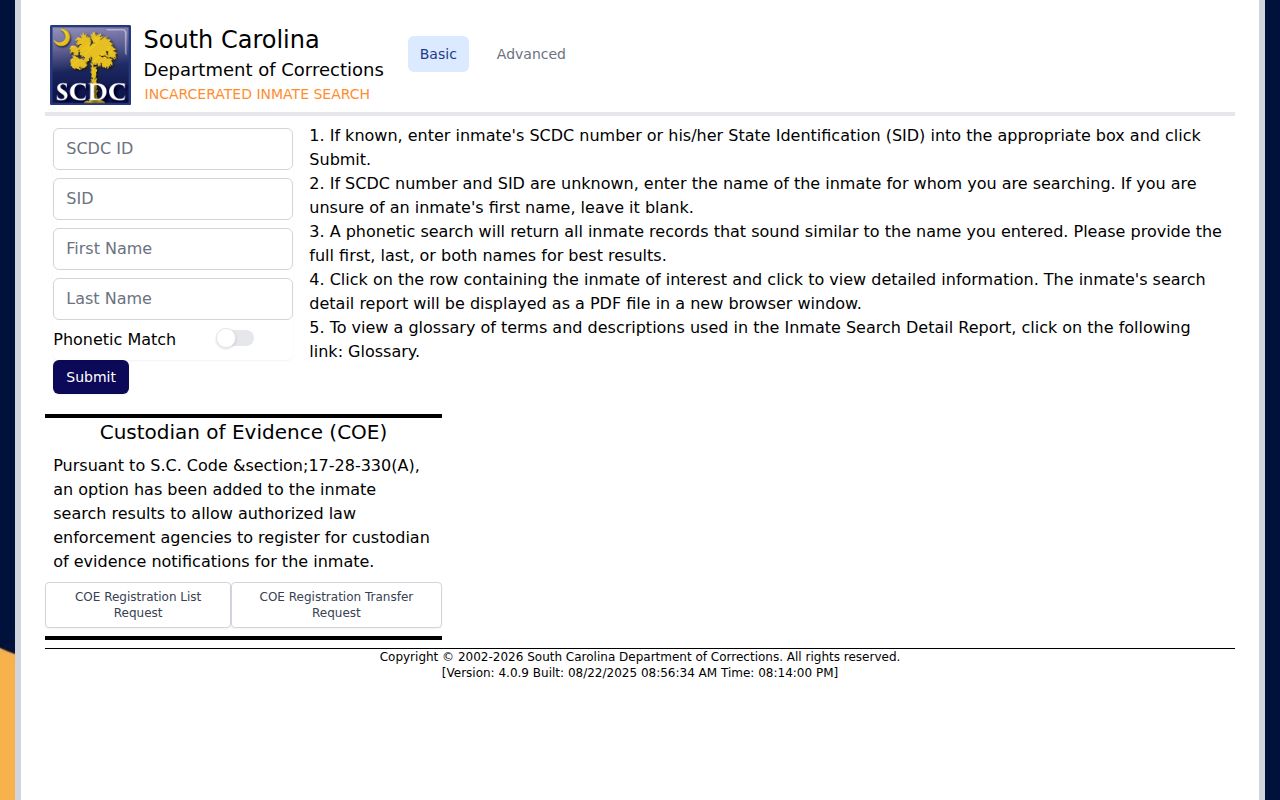
The image belongs to the state-prison path. It must not be presented as a McCormick County jail release archive.
McCormick Release Date Credit Rules
South Carolina’s Title 24, Chapter 13 supplies the sentence-credit framework. Section 24-13-210 awards eligible ordinary SCDC sentences twenty good-conduct days per month. A no-parole sentence receives three days per month, subject to statutory limits, exclusions, and forfeiture. For a person sentenced to a local detention facility or county public works, the statute provides one day for each two days served, subject to good conduct.
Section 24-13-230 covers qualifying work and education credits. Eligible non-no-parole SCDC sentences may receive up to one day for each two days of qualifying activity, with a combined annual cap of one hundred eighty days. No-parole sentences use a smaller monthly and annual allowance and cannot cross statutory floors. Local productive-duty credit rates must be set and published by the local official. No such McCormick schedule was located.
A “no parole offense” is defined in Section 24-13-100 by offense class and potential punishment. Section 24-13-150 generally requires at least eighty-five percent of the actual unsuspended term before early release, discharge, or applicable community supervision. Credits cannot reduce the term below that floor. The separate eighty-percent threshold in Section 24-13-125 concerns work-release eligibility, not final discharge. Section 24-13-175 uses a 365-day calculation year.
These rules are inputs, not a safe hand calculation for one person. Sentence dates, prior or later convictions, concurrent or consecutive terms, exclusions, and credit records can change the result.
Jail credit is another key input. It accounts for eligible time already spent in custody before or during the sentence as directed by the court and corrections record. A sentence length alone can therefore point to the wrong calendar date. Obtain the recorded jail-credit entry and any corrected order instead of subtracting dates without the agency computation.
McCormick Release Calculator Limits
South Carolina offers a public Release Date Calculator, but its own disclaimer sharply limits the result. The calculator produces an earliest possible case scenario. It assumes all possible credits will be earned, does not calculate the actual date for a person already sentenced, and may omit prior or subsequent convictions that affect status. It is not designed for Youthful Offender Act sentences.
This is the distinctive McCormick projected-date trap. The state publishes both a real projected field and a calculator, yet neither proves an actual release. The public tool can help explain a hypothetical sentence. It cannot replace the record maintained for an identified prisoner.
For a specific SCDC calculation, contact Inmate Records at 803-896-8531. Ask for the computation history when the date itself is disputed. A narrow request should include the SCDC ID, full name, projected date in question, and the relevant sentence or credit record.
Note: Do not use the public calculator to override the projected date or sentence history maintained in an identified SCDC record.
Why McCormick Release Dates Change
A projected release date changes when one of its legal or administrative inputs changes. SCDC disciplinary policy OP-21.11 says a loss of good time entered in the automated system causes the new projected date to appear the next day. Other changes may enter on a different timetable. Compare the display date before treating two screenshots as a conflict.
| Change | Effect on the date | Best record |
|---|---|---|
| Good-time loss or restoration | Moves the projection as credits are removed or restored | SCDC credit and discipline history |
| Work or education credits | May move an eligible projection earlier within legal floors | Credit ledger and sentence computation |
| Corrected sentence or jail credit | Changes the term or time already credited | Court order and computation history |
| Concurrent or consecutive structure | Changes how multiple terms combine | Sentencing orders and SCDC calculation |
| Detainer or hold | May end one custody while another begins | Release type, detainer field, and receiving authority |
| Parole action | Eligibility or a grant may create a conditional path | Board result, effective release record, and PPP |
A detainer deserves special care. If SCDC ends custody with a detainer indicator, the person may move directly to another authority. The SCDC date remains a release from SCDC, but it should not be rewritten as a return to the community.
Parole also creates a sequence rather than one date. Projected parole eligibility is the point at which consideration may begin under the governing sentence law. A hearing result can approve, deny, defer, or later rescind action. Only the effective SCDC release record confirms that prison custody ended, and PPP then confirms any active community supervision.
Confirm McCormick Actual Release Dates
For state custody, the SCDC Released Inmate Search is distinct from the current search. It accepts a release-date range and county selection and returns an affirmative row with SCDC ID, release date, release type, and county. An export may add detainer and other fields. That row is stronger online evidence of state-custody departure than disappearance from the current search.
For county custody, call McCormick County Detention Center at 864-852-0058 and request the timestamp and release or transfer code. Then inspect the court docket for the bond, disposition, sentence, or later order. If the jail identifies transfer to SCDC, follow the state search. If it identifies another authority, that authority must confirm what happened next.
A future custody alert can supplement this record path. The McCormick County VINELink release check explains the one-person search and notification process. VINE reports participating events and may lag. It does not replace the release record or court order.
For a fuller SCDC record, send a narrow request to FOIA@doc.sc.gov for the release or discharge summary, computation history, relevant credit ledger, release type, and receiving authority. This preserves the difference between a projection and the event that actually occurred.
Keep the date’s label with every note or copy. “Projected Release Date,” “Projected Parole Eligibility,” and “Release Date” describe different fields. Record the system, its as-of date, and the exact wording. That small practice makes later changes easier to explain and prevents an estimate from being repeated as a completed discharge.
Note: An affirmative release record has more evidentiary weight than a projected date that simply arrives or disappears.
Public Record Search
Sponsored Results